Ch. 1. Greensboro Beginnings: 1955-1970

1955-1970. Beginnings
Let’s begin at the very beginning. My parents were married on Easter Sunday, April 10, 1955. Daddy was taking Mama to work in late November when her water broke, unexpectedly. By 11 am I had arrived. Now, Mama used to say I was her special 7-month baby. In support of that calculation, she was headed to work, not expecting my arrival for another two months. Also, in support of that calculation, she told me that she had eaten some clam chowder several weeks earlier and got sick and decided just to stop eating. Dr. Evans told her she had to eat for her baby. She resumed eating, but I think the die was cast. My sister and my wife both say I was my parents’ love child, that it was a normal pregnancy, and that I must have been conceived prior to their marriage. I’m going with my mother’s story, though there are worst things than being a love child!
I cannot remember a time in my life when I couldn’t read and write. There must’ve been a time, but I certainly do not remember it. I remember reading bible verses in Sunday School and writing letters to my aunts and cousins, all before first grade. Mama would sit at the kitchen table with her stationery and fountain pen and write letters to friends and relatives who I’d later understand to be participants in the Great Migration. Chicago, Pittsburgh, New York all stand out in my memory as destinations for her letters. She’d allow me to write a paragraph inside the letter, showing off her son’s writing skills perhaps.
My handwriting, maybe because I started writing before developing necesary hand motor skills, has always been awkward, distinct, unique. (In later years I’d blame my handwriting on the mefloquine, a malaria suppressant I took while in West Africa). Sheila (my sister) says she can recognize my handwriting from a mile away.
Speaking of which, both my parents had traveled away as teenagers, one north and one midwest, but returned and began their adult lives in Greensboro, NC, a bit of a migration from the rural farming towns nearby where they grew up. Mama, after finishing a junior college secretarial program in Jacksonville, Fl, got a job in Chicago where she had relatives. She didn’t stay too long. Daddy moved to Washington, DC and stayed with Cousin Colina immediately after finishing high school. But it was in the midst of the Great Depression and there was no work to be found.
Daddy would tell a story about being on Pennsylvania Avenue in DC in 1933 when a truck rolled up, hauling people to Florida to pick oranges. He signed on and traveled to Florida, but he hated picking oranges! He saved his earnings until he could afford a bus ticket back home. “You can always go back home,” he would tell me in later years when he told the story. He wouldn’t travel again until World War Two, where he experienced combat action with the Army Air Corps in Italy.
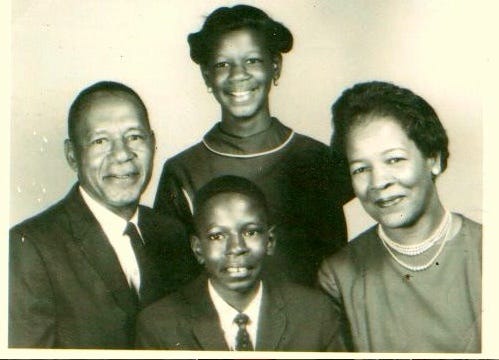
Our nuclear family. Clockwise from the top, my sister, Sheila Anne, my mother, Sallye Anne Hairston Maxwell, me, and my father, Raymond Robert Maxwell
I remember helping Mrs. Cooke, my first grade teacher at Bluford, with other students having their first exposure to reading lessons. I was already an advanced reader at that point, having learned and practiced at home. I think, in retrospect, that learning to read early, so early, was one of the great family legacies of slavery and emancipation. Enslaved children and adults were forbidden by law to learn to read and those rules got more stringent after the Nat Turner rebellion in 1831. Black people had a deep hunger for literacy, and through writing letters they sought to reunite with family members who had either moved away or had been forcefully relocated.
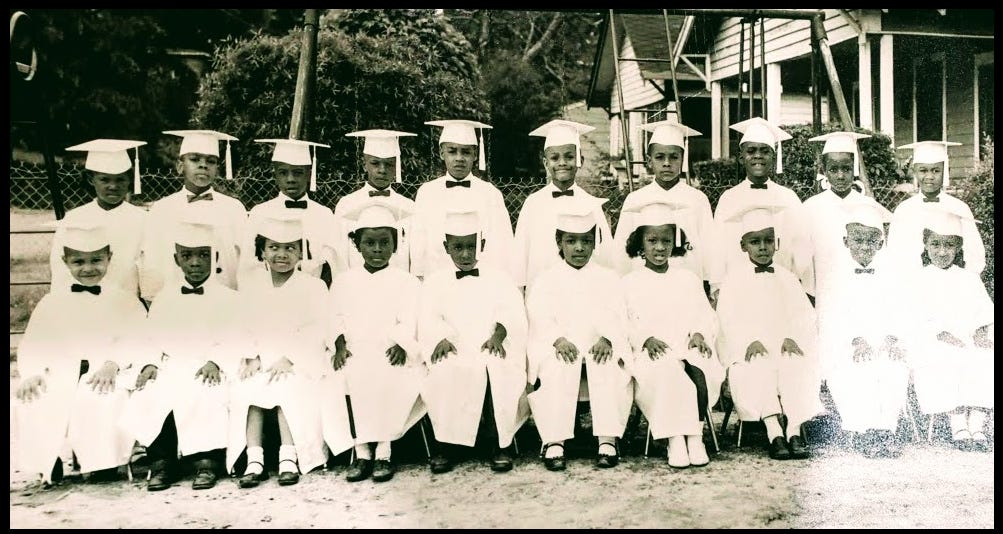
Class of 1961 at Metropolitan Day Nursery and Kindergarten. (I am 4th from the left on the back row.)
I should also mention that everything described here took place in Greensboro, NC, mainly in the Dudley Heights community. On Sundays we’d take road trips to see my dad’s family folks in the Jackson community of Brown Summit, NC, just a few miles up US 29, or to see my mom’s folks in Draper, NC, a few more miles up US 29. Our whole lives existed within that one hour radius.
I haven’t said much about the other kids in our African village. And that’s what it was, an African village. I’ve seen enough of them to know.
Pete across the street was an expert at shooting marbles. People would come from other neighborhoods and Pete would beat them and take their prized marbles from them. Bobby was the engineer. He could take your bicycle, or your television completely apart and put it all back together again. I think he actually became an engineer. Kenny was a great all-around athlete, though he ended up playing baseball and tennis, both spring sports. The Banks boys were intellectuals, militants, and entrepreneurs. I remember them during high school excelling in ROTC precision drilling and something called Junior Achievement. Joey was a ping-pong champion. He went to other cities and states playing ping pong. I don’t know whatever happened to Joey. And there were just average guys like me, a good student who became a fairly decent middle distance runner. Nothing special.
Claudette Alexander was the first of our generation to pass on. Then Robert Swann, from injuries he got in Vietnam. Pete Peterson passed while I was overseas. Michael Banks, Janet Banks, Skip Bryant, and just a couple of years ago, Annette Anderson. “The innumerable caravan that moves to that mysterious realm.” Annette had been sick on and off for a couple of years. Cancer. She fought it valiantly. I wrote an elegy sonnet for her.
I remember weekly trips with my dad and my sister, Sheila, to Carnegie Negro Library to check out books. Daddy was superintendent of Sunday School at his church and would go upstairs to the adult division to research his lesson, leaving us free and unattended to roam the basement where books for children, teens and young adults were kept. I developed an early love for the library and for librarians.
Daddy’s day job was as a parts clerk at an electrical parts shop. On the weekends he did electrical work, mainly on old houses out in the country, wiring receptacles, wiring whole houses. Most of his in-town work involved installing 220 volt receptacles for air conditioning units, the newest rage at the time. He was a fairly proficient electrician. A good electrician, in fact. But something happened somewhere along the way and alcohol became his mistress. All his electrical tools just walked away.
Daddy bought me the 24-in-1 electronics kit (Norelco) where you could build projects on a peg board. That was third grade. (Just checked and that kit is still available on Ebay in the original box. Amazing!) I fell out of love with libraries and in love with building electronics stuff, radios, musical keyboards, light and moisture detectors, etc., which was probably the point! Also in the third grade I began playing viola and did that right up through 8th grade jayvee football.
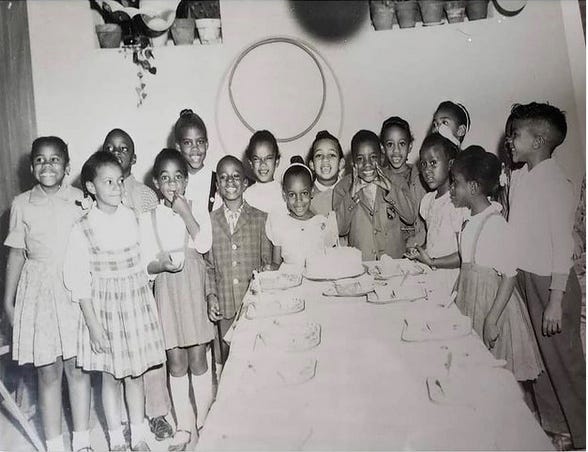
A Pichard Street birthday party. I think this was 2nd or 3rd grade.
My third grade running buddies were Dale Hall and Byron Griffin and we were together all the way through elementary school thanks to the tracking system they had us in, i.e., academically gifted and talented, whatever the heck that meant.
My mother had trained to be a secretary and did secretarial work in her day job and in community and church-related groups. But she stopped working when we started elementary school. Later, she felt like she needed to return to work when Daddy’s work became inconsistent. She did domestic work for a while, and hated it. She returned to secretarial work, which she did until her untimely death at 56.
Byron, Dale and I were selected and trained by the school librarian, Mrs. Burnett, to test for and get the audio-visual equipment operating license. Once we got it, we could operate all audio-visual equipment in the classroom. Sometimes we’d go to other classrooms to operate 16mm projectors. That was pretty cool. Of course, only boys were selected. That was a 60’s thing that I hope is different in these times.
I remember questioning in junior high why boys could not take home economics. Didn’t we need to know how to do that stuff like cooking and house cleaning and keeping a budget? One more note on the gender subject. I went with my sister to sign up for the summer dance program. They told me they weren’t taking boys.
Dale knew how to cuss and I desperately wanted to speak that new language. Somehow Mrs. Morrison caught us practicing the new language in 4th grade and gave us a stern lecture about people using profanity because of limitations in their vocabulary. She never told our parents and we never got into trouble at home for it. But I remembered what she said to us. I think we also bonded with her as a result.
We’d all go to Hook Street to play in the woods after school. Dale kept a carton of Kools in a hollowed out stump by the creek. We would sneak and smoke Kools and cough and act like we were grown.
Byron lived out beyond the Mt. Zion community where Daddy had a lot of relatives. His mother would pack us sandwiches and we’d go out exploring in the woods on weekends for several hours at a time.
It was the 4th grade when I started reading whole books. I don’t mean kiddie books, but what would now be considered teen and young adult fiction. There was the book about the puff snake, and the book about the time-traveling boy who came back to play in a professional baseball game. That year I also started with the Newberry Award classics: I, Juan de Pareja; A Wrinkle in Time; Shadow of a Bull. My favorite book, which I read cover to cover, over and over again, was The Adventures of Huckleberry Finn.
In the fifth grade I discovered the black classics, no doubt assisted by my favorite teacher of all time, Mrs. Lillian Jeffries Kennedy. Mrs. Kennedy and my father grew up together out in Brown Summit, just 16 miles away. Or maybe it was just Washington Street School and Dudley Senior High. I always suspected something had gone on between them back in the day. She brought me dog-eared copies of the Richard Wright novels, Black Boy and Native Son. I didn’t understand everything I read, but plowed through it nonetheless.
It was also in the fifth grade when we wrote and submitted essays for local competition, entitled ”What Americanism Means to Me.” It was a kind of combined writing and civics exercise, and I remember drawing ideas from the nation’s founding, the Civil War, and the then current civil rights struggle. None of us at Bluford School won the competition. I believe it was city-wide.
Then Mrs. Kennedy kept us for the 6th grade, she said she loved us so much but it may have been a purely administrative thing. She graduated my extracurricular reading to Ellison’s Invisible Man, The Autobiography of Malcolm X, and all the James Baldwin paperbacks at the time, Go Tell It On the Mountain, Notes to a Native Son, Nobody Knows My Name, and The Fire Next Time (the mother of a gal pal who was also a teacher would later introduce me to Giovanni’s Room and Blues for Mr. Charlie. I read through both with a more mature relish). And poetry. Mrs. Kennedy taught us poetry that we would memorize, and monologues from plays and famous speeches and writings like the Declaration of Independence and Julius Caesar monologues. And there was viola twice a week with Mr. Scott and practicing at home.
Meanwhile, on the weekends, I would go with Daddy on electrical jobs. I’d be the one to crawl into attics and underground crawl spaces and between walls and pull the wires. Daddy would say “Don’t be scared now,” but truth be told, I was often terrified in some of those dark and damp spaces. Terrified! But I told myself I could do it and I wanted to help my dad and be a real electrician’s helper! Then after we were done, he’d take me fishing out in the country (most of the jobs were in rural areas in Guilford County) and that made it all worthwhile.
On Sundays, driving home from church, we’d stop at a very crowded Ethel’s Bakery on Gorrell Street for Sunday dinner rolls, jelly donuts if we were lucky, and, for me, comic books.
About church, it sounds pretty whack in retrospect but as children it all seemed very normal to us. We went to my mother’s Baptist church, United Institutional Baptist Church, for regular service on 2nd, 3rd, 4th, and 5th Sundays. But we went to my father’s Methodist church, Mt. Tabor United Methodist Church, every 1st Sunday for communion, unless it was the first Sunday of the quarter, when we reverted back to the Baptist church for communion which only happened quarterly. It didn’t take me long to figure it out. Was it a deal they struck? Might things have worked out better for them had we all attended the same church. Each had their reasons and, perhaps, their separate lives. I won’t be too critical in retrospect.
A song I remember from the Methodist church:
At the cross, at the cross where I first saw the light,
And the burden of my heart rolled away,
It was there by faith I received my sight,
And now I am happy all the day!
Another church memory. There was a point in the late 60’s when, in my young and impressionable mind, it seemed we were attending funerals at Institutional every Sunday, immediately after the 11am service. What I didn’t recognize at the time was that all those funerals were for soldiers who had died in Vietnam. Was it a conscious decision to hold there funerals right after the Sunday service to maximize attendance? Was Reverend Anderson making a political statement? I never got these questions answered.
At some point we, that is, the boys in our neighborhood, the 1400 block of Pichard Street, Kenny Swann, Pete Peterson, Rodney Alexander, Larry Banks and I discovered the wonders of riding our bikes down to Buffalo Creek to catch tadpoles and guppies and the occasional salamander. Then I’d transfer the tadpoles to a big metal tub in the backyard and watch everyday as they turned into little frogs and escaped. One day we discovered that the stream at the end of our street was just a runoff tributary to the real Buffalo Creek. As we walked along the side of the stream, all of a sudden the grass got higher and the water got deeper and we got more and more afraid and began to backtrack to safety. When I told my father about it, he drove me out to a bridge on Willow Road that crossed the real Buffalo Creek and showed me how water moccasins skimmed the surface and copperheads hung out on the shore. Never again would we “discover” Buffalo Creek tributaries!
We (my sister and I) attended two weeks of Vacation Bible School each summer at Institutional (United Institutional Baptist Church, where our mother had been a member since moving to Greensboro in the 1940’s) up to about the 5th grade. We’d arrive at 9 am for a small devotional, hymns and prayer, go to our respective classrooms based on age, and attend a small devotional at noon followed by a lunch of potted meat sandwiches and kool-aid. Gotta have that kool-aid! I remember having a huge crush on a girl named Judith George. We lost contact over the intervening years.
It was there I finally figured out, singing those songs from the Bible School hymnal made especially for us, that religion was all about behavior control. I was able to find the lyrics of one of the standard songs we sang, every morning, on the internet:
Spirit of God, descend upon my heart;
Wean it from earth; through all its pulses move.
Stoop to my weakness, mighty as Thou art,
And make me love Thee as I ought to love.
In the 5th grade I joined the Boy Scouts. It was Camp Wenasa every summer and sometimes twice a summer. (Note: Camp Wenasa had just integrated and black scout troops were allowed to participate. Occasionally, my troop alone, Troop #442 sponsored by Grace Lutheran Church, would go to Camp Carlson, an old abandoned camp where black troops used to go on weekend camping trips before integration, the colored camp as it was known. End note.) I would lug books with me for reading between camping and hiking and campsite projects and merit badge meetings. Every merit badge dealing with nature and conservation, and every one related to electronics, radio and computers was on my merit badge sash, along with a few of the required ones. And Camp Wenasa had the best blueberry pancakes for breakfast in the dining hall!
There are skills I acquired in the Boy Scouts that I’ve relied on throughout life. Compass and map-reading skills pay dividends even though we use GPS on our phones for everything. Planning for hiking and camping trips informed later project and program management talents that have served me well. In the Boy Scouts I learned social skills for dealing with people who were not like me, not from my neighborhood, not members of my church. It was my first experience with human heterogeneity.
It couldn’t have been long after that the movie theaters integrated in Greensboro. Mama called and said she was getting off work early and I needed to meet her downtown for a surprise. We met at the bus stop and she took me to a movie theater on Elm Street, across the street from Woolworth. Yes, THAT Woolworth. Was it the Center, or the Cinema? I can’t remember. But I remember the film. It was To Sir, With Love, starring Sidney Poitier and a British girl who became a top hit singer. Can’t remember her name. Mama wanted to see the film and I guess it was a training opportunity for me. We got popcorn and found a seat downstairs, not in the balcony where Negroes used to have to go in the National or the Carolina. I fell asleep. Mama really enjoyed the film, though. I didn’t quite understand the parts I didn’t sleep through. My first movie date.
I think this was the same summer that I ended up with three yards to cut. Mr. Foster on Lincoln Street and Mr. Speight on Benbow Road had their own lawn mowers and I just had to show up and push. And there were always nice snacks. For Mrs. Whitehead on Lincoln Street I had to bring the lawnmower from home, but it was just a block away. And paid a bit better. And no snacks! It could have been an every summer gig had I stuck with it, but in the 7th grade I chose to go out and get a summer job with a local government outfit called the Neighborhood Youth Corp (or something like that). I started out with library work at Gillespie Park School and finished the summer doing windows and janitorial work at UNC-G.
This would have been around 1968, the year of King’s assassination. UNC-G counterculture was at its height – bookshops, used record stores, funky restaurants. I remember buying my first John Coltrane album, Sunship, and I discovered in a Tate Street, called Daedalus, the Franz Fanon trio, The Wretched of the Earth, Black Skin White Masks, and A Dying Colonialism. Heady reading for a rising 8th grader but I was up for it.
I was headed to Eagle when time ran out. I quit Scouting (at the rank of Star) and the viola in exchange for 8th grade football. Not sure why but at the time it was one or the other. I “went out” for Lincoln’s jayvee team and survived summer training. Coach Kanoy made me jayvee captain and I played offensive and defensive end and every special team. We only had five games but we went undefeated and unscored upon. I knew I had a future in the NFL! We’ll come back to that in a subsequent post. Maybe.
The Carnegie Negro Library moved from Bennett College campus and became the new Southeast branch of Greensboro Public Library after integration. Hanging out with the big boys, Reggie Greene, Skip Bryant, and Rodney and Bobby Alexander, we biked downtown to the Central Library to get library cards immediately after integration came. I didn’t tell my parents until we got back. I got in a bit of trouble for that.
The librarians all transferred from the Carnegie Negro Library to the Southeast Branch so we already knew them and they knew us. We’d go every afternoon for homework and flirting with girls who went to different schools, evenings during football season.
Kenny and I took over the newspaper route in the summer between my 6th and 7th grade year. We had about 100 customers across Dudley Heights. Kenny did Pichard and Dunbar Streets and I covered Lincoln and Hook Streets. The four or five dollars a week we cleared after paying the weekly paper bill kept us in comic books, a summer that began innocently enough with Superman and Batman and the Fantastic Four and ended with Daredevil, Spiderman, and, wait for it, Sgt. Fury and his Howling Commandos (the rising Vietnam influence). And the occasional movie at the National Theatre (where blacks still had to sit in the balcony) and the Carolina (same seating arrangement except the Carolina actually had a separate outside entrance), and french fries at a seedy downtown Greensboro bar that we should not have been going to.
In the spring of my 7th grade year, our French teacher Ms. Brown took three of us to UNC-G for language testing we were not prepared for, but it was an interesting, and obviously, memorable experience! I always felt so sorry for Ms. Brown, the only white teacher at Lincoln Jr. High, who had to endure a lot of abuse from students that was clearly racially motivated. She was young, and I think it may have been her first job out of college. She had a soft but distinct southern accent that replicated itself in every dialogue we memorized. But back to the test experience. We sat in little booths and listened to a guy narrate in French, then ask us questions. I was completely lost as were my classmates and I think Ms. Brown knew it. But it was one of those formative things. Afterwards she took us all to Burger King on Summit Avenue, a fairly ballsy move for her and for us back then, considering the most racist motorcycle gangs in town all hung out in the parking lot at that Burger King.
Also we were in a special writing program in the 7th grade. A white lady would come to Lincoln from downtown, pick up our compositions, and drop off the ones from the prior week full of red marks. We'd get two grades, one for style and originality (on the top), Composition, and one for grammar and punctuation (on the bottom), Mechanics. I always aimed for the A/A but didn’t always get it! At the end of the year, we did a long paper on a subject of our choosing. I chose as my subject the Negro Cowboys. I wrote about Nat Love, also known as Deadwood Dick, and Bill Pickett, and my favorite, Bass Reeves, the original Lone Ranger. When it came back there was a note from the white lady saying she had never heard of Negro Cowboys. A full 25 percent of cowboys were black. Maybe even more.
The reading never stopped. Not that I understood everything I read, but a lot of it was beginning to make sense. I especially loved reading the steamy stuff in the coming of age books, Manchild in the Promised Land, Down These Mean Streets, and The Learning Tree. We passed that stuff around like it was pornography. For us it was pornography.
The first “black” bookshop in Greensboro was a place called The House of Weusi Umoja (Swahili for “black unity”) on the corner of Benbow Road and Market Street just on the edge of A&T College campus. It was run by a couple, Bill and Evie Adams. It became my new hangout as a rising 8th grader who loved to read and it was a heady time, immediately following the King assassination when the black revolution was coming into vogue. I seem to recall it was at The House of Weusi Umoja where I met college students forming a new youth movement, YOBU, Youth Organized for Black Unity. On the weekends we would meet at a place called the Sebastian House, just four blocks up Benbow Road at McConnell Road, a block away from Grace Lutheran Church where I had previously belonged to Boy Scout Troop #442. At the Sebastian House we would do layout and editing of a nationwide-distributed newspaper, The African World. I got real good at measuring column inches and headline layout and thought I may have had a future in journalism. The older kids graduated to SOBU, Students Organized for Black Unity and later in college they embraced something called Marxist/Leninist/MaoTsoTung Thought. I may touch on that in a later chapter.
About that same time, activist Howard Fuller set up Malcolm X Liberation University over on Asheboro Street. A girl from the neighborhood, Annette, went with me for Swahili classes. It was about a ten block walk. Fuller later moved to Milwaukee, got his PhD, and became a big man. I hear he recently retired.
It was our 8th grade year when they had the big riot at A&T that resulted in the sending of the National Guard to campus, the shutdown of the city, and the death of A&T student Willie Grimes in Scott Hall. There was a spillover at Dudley High School, right across the street from Lincoln, related somehow to the election of Connie Herbin as student body president and the write-in candidacy of Claude Barnes. The rioting spread to Dudley’s campus, the National Guard used tear gas to dispel the crowd, and a cloud of tear gas drifted across the street to Lincoln, making us all sick with runny noses and swollen eyes. I remember we all gathered in the Auditorium, where our parents picked us up at midday.
It was the summer between 8th and 9th grade when I met the Baha’i people and the Black Muslims. Both groups had folks going door-to-door in the neighborhood proselytizing. It was the same summer that I got my first summer reading list for Woodberry Forest and chose to read The Greening of America, Future Shock, Silent Spring, and Soul on Ice. Soul on Ice was, frankly, a tough read for a 14 year old!
Thus armed, I packed my belongings in a trunk and made the trip with my mother and uncle to Woodberry Forest.
******************************
A side note on getting the scholarship and meeting Dr. Kilimanjaro
Been sitting on this one since posting these tweets on my Dad’s birthday, January 12. There are only a few more days of Freedom of Expression, though. Come Inauguration Day, the Biden folks are going to squash all first amendment rights under the banner of whatever banner they choose. AOC’s new Ministry of Information plans to “curate” all truth to fit in with her/their idea of propaganda. Biden and Big Tech are on board. Information is dead. Democracy dies in darkness. But you can still buy a lottery ticket. Third highest jackpot ever.
It was a big deal when we got the prep school scholarships back in 1970. My next door neighbor, Mr. Gibbs, was an English teacher who worked part time for the Carolina Peacemaker, a local newspaper, one of two “black” newspapers in Greensboro (the other, The Future Outlook, had its day but moved on in the 70’s). Anyway, they decided to do a big feature article on the four of us who got the scholarships and Mr. Gibbs offered to arrange for me to meet the editor and publisher of the Carolina Peacemaker, John Marshall Kilimanjaro.
Dad drove me and we met Mr. Gibbs at the newspaper office. Of course, Dr. Kilimanjaro made us wait – that’s what important people do. At length he came out, looking like he had been asleep, clothes kind of frumpy and wrinkled. But he was friendly. We sat down around a coffee table filled with magazines and old newspapers. I was eager to impress.
Dr. Kilimanjaro said to me, “Son, what do you want to be, what do you want to do with this high falutin’ education you are about to get?” He only had daughters, so calling me “son” was a high honor. I told him, and it was true that week, that I had an interest in history and African American studies, but that I really wanted to be a journalist. He looked at me with that piercing look and said, “Son, you don’t want to be a journalist, journalists can’t pay the rent. You want to be a newspaperman. Layout, design, advertisement, subscriptions, content.” I thought to myself, almost out loud but I managed to suppress it, shouldn’t content be first in that order?
Then he nodded off and was out for about ten minutes. We waited. When he awoke he thanked us for coming by and wished me luck. Narcolepsy, maybe? I don’t know.
It would come full circle years later when, processing a collection at Howard University’s Moorland Spingarn Research Center, I came across a letter a young John Marshall Stevenson (Kilimanjaro’s original name) would write to a Howard medical school professor about preparations for med school. He ended up a English and drama professor before going into newspapering. I think his daughters still publish the newspaper in Greensboro.
I have had dreams about returning to Greensboro and running a newspaper. Not sure what the demand is for black newspapers anymore. I’d call my paper The Greensborough Patriot, after a pre-Civil War rag that lasted for a couple of decades. Who knows? It’s never too late, but it might not be feasible in the new Biden information environment.
Poetic reflections on, not from the period
Ernest Rankin: In Memoriam – an elegy in two sonnets for Father’s Day
my favorite uncle had no children
of his own – he lavished his attention
on his nieces and nephews – my father
was one of those. Ernest Rankin. Iceman,
they called him – he sold ice in the summer,
coal in the winter. He drove a green cab
by the time I came along, his ice days
long gone. He kept a red fez in his house,
and a sparkling sword, polished, in the trunk
of his cab. 33rd degree. My Mom
would call him when Pop’s drinking got too much
for her to handle. He’d come over, talk
to Pop like a father would to a son –
it never did my father any good –
but for some reason it had an appeal
to me – I saw how two grown men who cared
should communicate with one another.
Uncle Ernest lived in town and moved in
his niece and nephew so they could attend
high school and college away from the needs
of the farm. He made a difference in their lives,
shifting their trajectories, opening pathways.
Old men in the Grove would ask me,
“Son, whose boy are you?” “Iceman’s my uncle,”
I’d tell them, and they would change their tune to
one of reverence and respect. That meant
a lot to me, that shared identity.
White-aproned men performed his final rites.
Some buds on the rose bushes
Some buds on the rose bushes
are barely visible, tiny, hidden
between thorns and leaves.
Some, fully blossomed, attract
our vision, their fragrance, our
Noses and our wandering thoughts.
The ones between appeal only
to the bees and butterflies,
and to careful gardeners with
pruning shears. My mother wore
white gloves when she "cut up"
the rose bushes, and a wide-brimmed hat,
and a scarf wrapped round her neck.
Going fishing
Going fishing with Daddy
in Browns Summit
was about as good as good got:
Saturday at sunset,
electrical jobs all done and
poetry memorized.
Time for some fun!
Long cane pole,
worms from the spring bed,
fish too small to eat –
but catching ‘em was fun anyway.
Daddy’s long gone,
and the fishing pond is dead too –
irrigation for some organic tobacco fields –
what’s left is a smaller,
dark brown puddle,
and poison ivy,
and chiggars on wild blackberries
where the edge used to be.